Mahmood Awan (The News on Sunday, 28th December 2025)
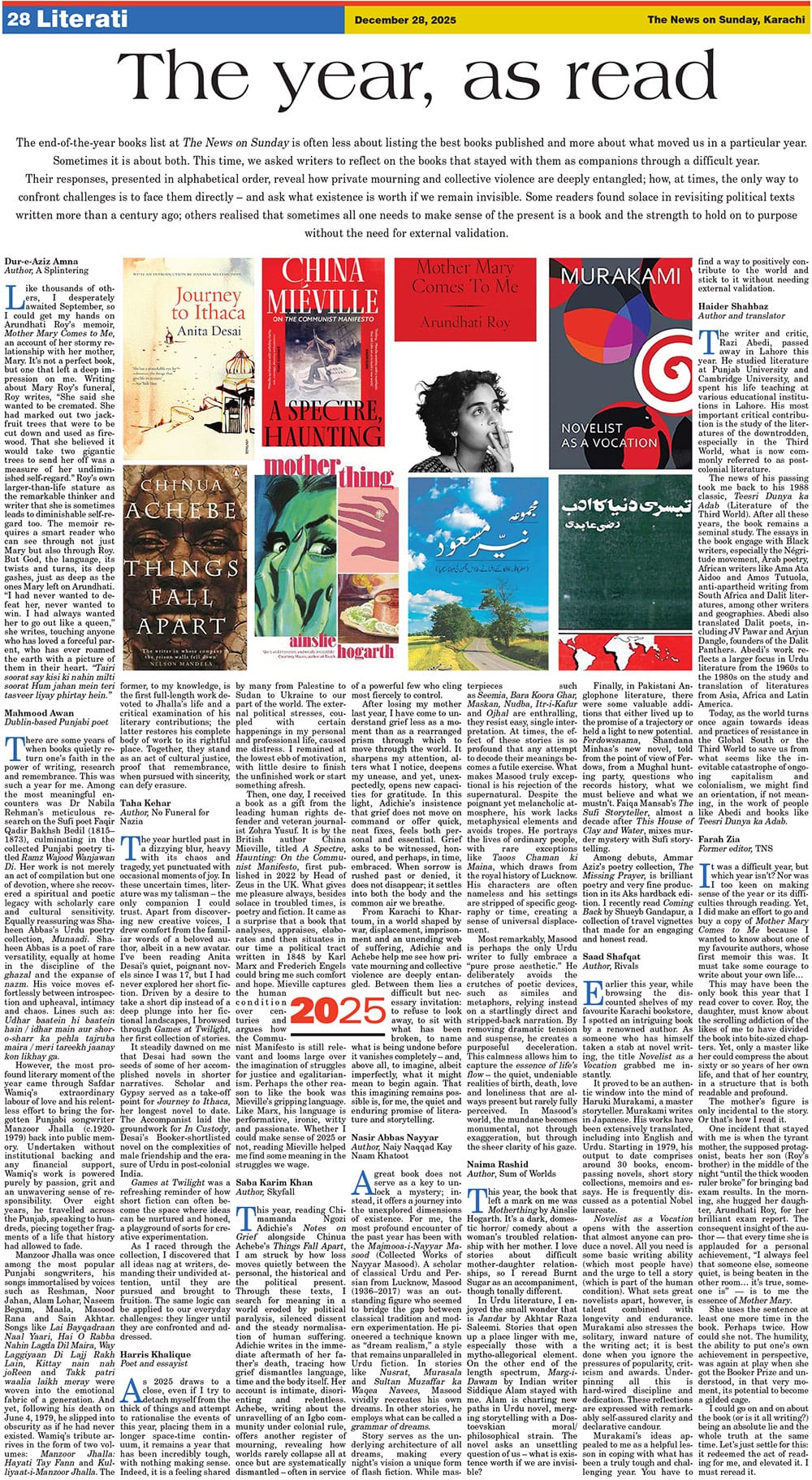
There are some years of when books quietly return one’s faith in the power of writing, research and remembrance. This was such a year for me. Among the most meaningful encounters was Dr Nabila Rehman’s meticulous research on the Sufi poet Faqir Qadir Bakhsh Bedil (1815–1873), culminating in the collected Punjabi poetry titled Ramz Wajood Wanjawan Di. Her work is not merely an act of compilation but one of devotion, where she recovered a spiritual and poetic legacy with scholarly care and cultural sensitivity. Equally reassuring was Shaheen Abbas’s Urdu poetry collection, Munaadi. Shaheen Abbas is a poet of rare versatility, equally at home in the discipline of the ghazal and the expanse of nazm. His voice moves effortlessly between introspection and upheaval, intimacy and chaos. Lines such as: Udhar baatein hi baatein hain / idhar main aur shor-o-sharr ka pehla tajruba maira / meri tareekh jaanay kon likhay ga.
However, the most profound literary moment of the year came through Safdar Wamiq’s extraordinary labour of love and his relentless effort to bring the forgotten Punjabi songwriter Manzoor Jhalla (c.1927-1973; see note below) back into public memory. Undertaken without institutional backing and any financial support, Wamiq’s work is powered purely by passion, grit and an unwavering sense of responsibility. Over eight years, he travelled across the Punjab, speaking to hundreds, piecing together fragments of a life that history had allowed to fade.
Manzoor Jhalla was once among the most popular Punjabi songwriters, his songs immortalised by voices such as Reshman, Noor Jahan, Alam Lohar, Naseem Begum, Maala, Masood Rana and Sain Akhtar. Songs like Lai Bayqadraan Naal Yaari, Hai O Rabba Nahin Lagda Dil Maira, Way Laggiyaan Di Lajj Rakh Lain, Kittay nain nah joReen and Takk patri waalia laikh meray were woven into the emotional fabric of a generation. And yet, following his death on January 25, 1973 (see note below), he slipped into obscurity as if he had never existed. Wamiq’s tribute arrives in the form of two volumes: Manzoor Jhalla: Hayati Tay Fann and Kulliyaat-i-Manzoor Jhalla. The former, to my knowledge, is the first full-length work devoted to Jhalla’s life and a critical examination of his literary contributions; the latter restores his complete body of work to its rightful place. Together, they stand as an act of cultural justice, proof that remembrance, when pursued with sincerity, can defy erasure.
NOTE: According to Safdar Wamiq’s research, Manzoor Jhalla passed away on January 25, 1973, and his year of birth was 1927 (page 62 & page 97 of his Hayati tay Fann book). In The News published piece circa c. was used to show conflicting claims about his year of birth and death as shown on his headstone, and speculated around, ie (c.1920-1979).
Published on 28th December 2025 in The News on Sunday.