Mahmood Awan (The News on Sunday, 7th December 2025)
The University of Engineering and Technology, Lahore, stands apart as an institution that has not only produced world-class engineers, architects, technologists, civil administrators and teachers, but also made an enduring contribution to Pakistan’s literary and cultural landscape.
Within its highly technical ecosystem, the UET has nurtured a strong tradition of poetry and thought, a tradition that has passed gracefully from one generation to the next. From Faisal Ajami, Ghafar Shahzad, Tayyab Raza, Rehman Hafeez, Shaheen Abbas, Naveed Sadiq, Akbar Nasir Khan, Idris Babar, Zulfiqar Adil, Saleem Sagar, Manzar Ijaz and Asif Shafi to Faizan Hashmi, Naeem Ullah Anmol and Nilofar Afzal, this list continues to grow.
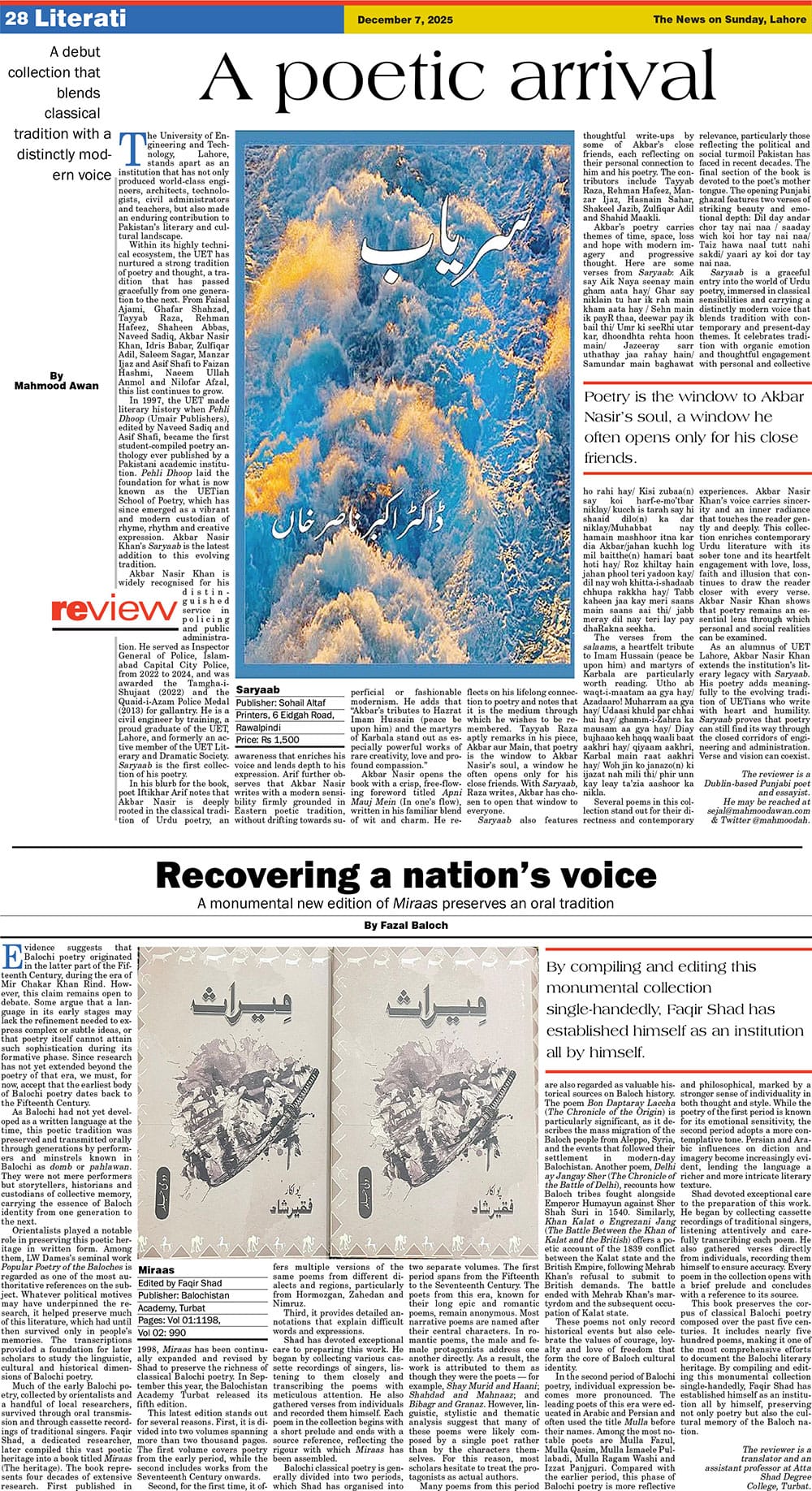
In 1997, the UET made literary history when Pehli Dhoop (Umair Publishers), edited by Naveed Sadiq and Asif Shafi, became the first student-compiled poetry anthology ever published by a Pakistani academic institution. Pehli Dhoop laid the foundation for what is now known as the UETian School of Poetry, which has since emerged as a vibrant and modern custodian of rhyme, rhythm and creative expression. Akbar Nasir Khan’s Saryaab is the latest addition to this evolving tradition.
Akbar Nasir Khan is widely recognised for his distinguished service in policing and public administration. He served as Inspector General of Police, Islamabad Capital City Police, from 2022 to 2024, and was awarded the Tamgha-i-Shujaat (2022) and the Quaid-i-Azam Police Medal (2013) for gallantry. He is a civil engineer by training, a proud graduate of the UET, Lahore, and formerly an active member of the UET Literary and Dramatic Society. Saryaab is the first collection of his poetry.
In his blurb for the book, poet Iftikhar Arif notes that Akbar Nasir is deeply rooted in the classical tradition of Urdu poetry, an awareness that enriches his voice and lends depth to his expression. Arif further observes that Akbar Nasir writes with a modern sensibility firmly grounded in Eastern poetic tradition, without drifting towards superficial or fashionable modernism. He adds that “Akbar’s tributes to Hazrat Imam Hussain (peace be upon him) and the martyrs of Karbala stand out as especially powerful works of rare creativity, love and profound compassion.”
Akbar Nasir opens the book with a crisp, free-flowing foreword titled Apni Mauj Mein (In one’s flow), written in his familiar blend of wit and charm. He reflects on his lifelong connection to poetry and notes that it is the medium through which he wishes to be remembered. Tayyab Raza aptly remarks in his piece, Akbar aur Main, that poetry is the window to Akbar Nasir’s soul, a window he often opens only for his close friends. With Saryaab, Raza writes, Akbar has chosen to open that window to everyone.
Saryaab also features thoughtful write-ups by some of Akbar’s close friends, each reflecting on their personal connection to him and his poetry. The contributors include Tayyab Raza, Rehman Hafeez, Manzar Ijaz, Hasnain Sahar, Shakeel Jazib, Zulfiqar Adil and Shahid Maakli.
Akbar’s poetry carries themes of time, space, loss and hope with modern imagery and progressive thought. Here are some verses from Saryaab: Aik say Aik Naya seenay main gham aata hay/ Ghar say niklain tu har ik rah main kham aata hay / Sehn main ik payR thaa, deewar pay ik bail thi/ Umr ki seeRhi utar kar, dhoondhta rehta hoon main/ Jazeeray sarr uthathay jaa rahay hain/ Samundar main baghawat ho rahi hay/ Kisi zubaa(n) say koi harf-e-mo’tbar niklay/ kucch is tarah say hi shaaid dilo(n) ka dar niklay/Muhabbat nay hamain mashhoor itna kar dia Akbar/jahan kuchh log mil baitthe(n) hamari baat hoti hay/ Roz khiltay hain jahan phool teri yadoon kay/ dil nay woh khitta-i-shadaab chhupa rakkha hay/ Tabb kaheen jaa kay meri saans main saans aai thi/ jabb meray dil nay teri lay pay dhaRakna seekha.
The verses from the salaams, a heartfelt tribute to Imam Hussain (peace be upon him) and martyrs of Karbala are particularly worth reading. Utho ab waqt-i-maatam aa gya hay/ Azadaaro! Muharram aa gya hay/ Udaasi khuld par chhai hui hay/ ghamm-i-Zahra ka mausam aa gya hay/ Diay bujhaao keh haqq waali baat aakhri hay/ qiyaam aakhri, Karbal main raat aakhri hay/ Woh jin ko janazo(n) ki ijazat nah mili thi/ phir unn kay leay ta’zia aashoor ka nikla.
Several poems in this collection stand out for their directness and contemporary relevance, particularly those reflecting the political and social turmoil Pakistan has faced in recent decades. The final section of the book is devoted to the poet’s mother tongue. The opening Punjabi ghazal features two verses of striking beauty and emotional depth: Dil day andar chor tay nai naa / saaday wich koi hor tay nai naa/ Taiz hawa naal tutt nahi sakdi/ yaari ay koi dor tay nai naa.
Saryaab is a graceful entry into the world of Urdu poetry, immersed in classical sensibilities and carrying a distinctly modern voice that blends tradition with contemporary and present-day themes. It celebrates tradition with organic emotion and thoughtful engagement with personal and collective experiences. Akbar Nasir Khan’s voice carries sincerity and an inner radiance that touches the reader gently and deeply. This collection enriches contemporary Urdu literature with its sober tone and its heartfelt engagement with love, loss, faith and illusion that continues to draw the reader closer with every verse. Akbar Nasir Khan shows that poetry remains an essential lens through which personal and social realities can be examined.
As an alumnus of UET Lahore, Akbar Nasir Khan extends the institution’s literary legacy with Saryaab. His poetry adds meaningfully to the evolving tradition of UETians who write with heart and humility. Saryaab proves that poetry can still find its way through the closed corridors of engineering and administration, where verse and vision can rhyme.
Saryaab:
Publisher: Sohail Altaf Printers, 6 Eidgah Road, Rawalpindi
Price: Rs 1,500
Published on 7th December 2024 in The News on Sunday.
https://www.thenews.pk/tns_staging/detail/1384915-a-poetic-arrival